

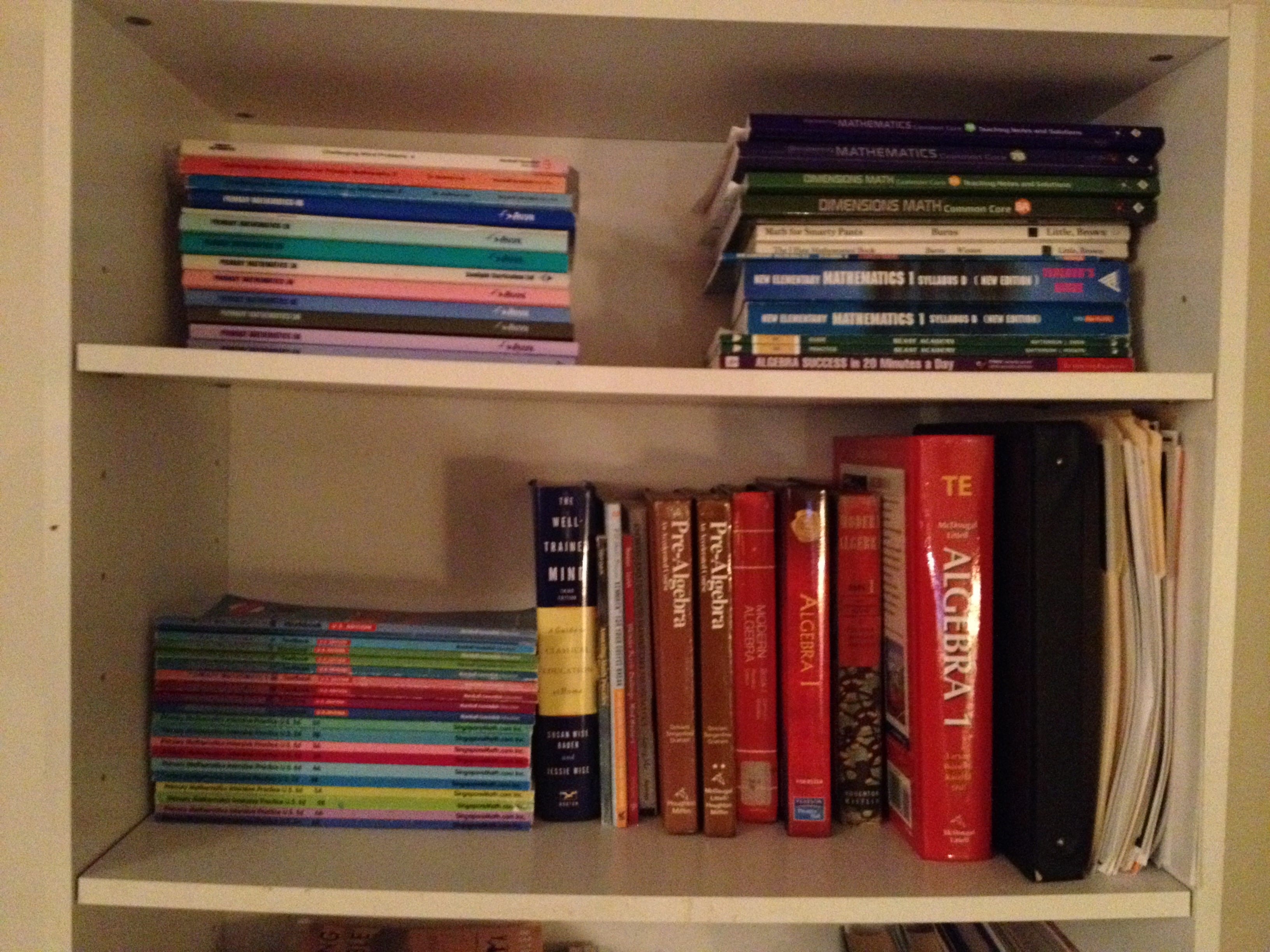
Because this is a dyslexia newsletter, I don’t write much about math, which is an oversight because our dyslexic kids can also struggle with fluency, speed and memorization in mathematics. One of the best resources I used homeschooling my kids was Singapore Math. I was a good math student, but knowing how to teach math was a different beast entirely. Singapore Math was widely recommended by other homeschoolers as comprehensive and rigorous. I started this program in K with my oldest and stayed with it until my third child moved on to public school. I used Singapore Primary Math, U.S. Edition throughout elementary and Dimensions Math for middle school
There are a number of reasons I believe this program worked especially well for my dyslexic kids. First, the program builds incrementally and logically, covering topics to mastery, integrating them into new topics, and returning to them in subsequent years with increased complexity. The constant use of previously learned material was exactly the sort of repetition my dyslexic kids needed. In other words, Singapore Math is an extremely well-designed curriculum.
Second, Singapore uses the CPA (concrete-pictorial-abstract) approach. Students are introduced to a topic using concrete objects like number blocks and bars and counters that they can group and organize. Then they move on to doing the same problems using pictures like drawn blocks or bars instead of physical blocks. Finally, they work these same problems using abstract representations (the picture of three blocks is replaced by the number 3). This approach develops a deep conceptual understanding that really played to my kids’ strengths. My dyslexic kids were not atypical in being big thinkers. They weren’t fast thinkers but they excelled at going deep. The CPA approach built an extremely solid number sense and understanding of place value. Even though every single one of them needed extra time for high school math, and they all had a tendency to make small transcription and arithmetic errors (as is typical of dyslexic students), they all succeeded in upper-level math.
Third, the Singapore program brilliantly uses bar models to help students attack word problems. Because reading requires a greater cognitive load for dyslexic students, having a way to transcribe word problems into pictorial models frees up space for problem solving. Global visual-spatial processing has even been found to be one possible strength of dyslexic brain organization. Each Singapore Math level comes with a supplementary Challenging Word Problems text to further build these skills. While we might expect word problems to be a weakness for dyslexic students, Singapore Math turned them into a strength for my kids.
Finally, Singapore teaches a wide variety of mental math strategies. Students learn how to add and subtract and multiply and divide in their heads using these strategies. For students who struggle with automaticity and rote memorization, as most dyslexic students do, these strategies are crucial. It was easier for my children to think about (9+8) as 1 less than (10+8) than to simply memorize the math fact (9+8=17). Memorizing math facts and multiplication tables can take a long time for dyslexic students. They typically require far more repetitions to commit facts to memory. Using these strategies gives them a highly valuable way to derive answers while they are amassing the repetitions they need.
I have three dyslexic kids who are all slightly different. While I used a variety of programs in other subjects to suit each individual child, Singapore Math worked extremely well for all three of my kids. When my youngest entered middle school in 7th grade, he was so skilled in math he didn’t actually learn anything new until he reached 9th grade. If you are looking for a solid, reliable math program that covers all the bases, Singapore Math is a fantastic choice.
I have enjoyed your past curriculum recommendations for dyslexic kids so much, and now I’m thrilled to hear your experience with math! We have added Lively Latin to our days, and it has been so great.
The math is timely, because we are now using Math-U-See, and I have been wanting to do some looking around before I commit to another year. I’m happy with it so far, but keep hearing that people often switch out of it, so want to do my due diligence.